Understanding Free and Open Source Software

January 5, 2010 by Cath · 1 Comment 

GNU-Free-as-in-Freedom

There are many misconceptions floating around about free and open source software (foss). The purpose of this article is to address them and to better inform people.

The first response I seem to get when I discuss ‘free software’ is, oh but you have to pay for quality, or maybe, well how can developers afford to give away software for nothing. Well in the first instance, free refers to liberty rather than cost. Freedom to copy, change and modify software and indeed you may actually pay for access to free software, although this is generally not the case. Software code is like any other type of knowledge; it should not be hidden from the user.

Another frustrating and misleading idea is that foss kills innovation. If anything free software is the key to innovative creation, we only need to look at Firefox web browser or Wordpress blogs to see non-proprietary software flourishing.

So you may ask why do we need to concern ourselves with free software if proprietary software works and can offer stability? In modern society computers, televisions and mobile phones are commonplace; indeed we have come to rely upon them. The software controls and transmits our sensitive information; we should be in control of this software and have a better understanding of how it works in order to maintain our liberty and control.

Other frustrating misconceptions about foss include political aspects. People at times assume that foss is akin to communism; this is a falsity. You can indeed have private ownership over free software, you can modify at will and can reap the rewards of its use. A free software licence only requires that if you do redistribute the software, that you must keep it free; allowing others to modify and redistribute. Or if you wish to keep your modifications private, you must ensure that the original free software is kept separate and that your addition does not contain the original work. The free software license is simply a legal and ethical contract between the programmer and the end-user.

I feel that whilst this information is relatively basic it is all to often taken for granted or misunderstood, so if this sounds repetitive then humour me please. Oh and Happy New Year!

Happy Birthday to GNU

September 3, 2008 by Chris · 4 Comments 

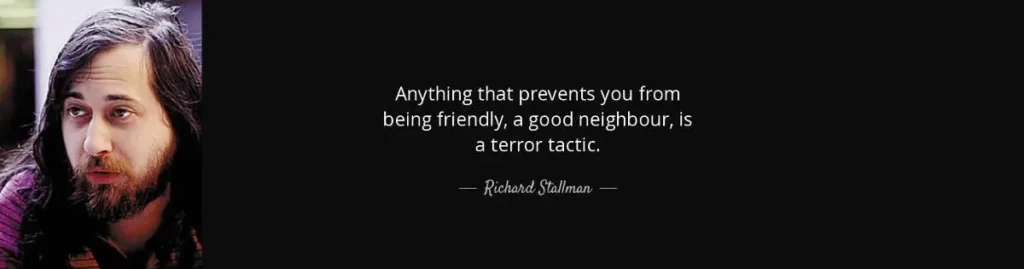
Richard_Stallman.jpg
Happy birthday GNU :) Thank you to all the GNU hackers that write free software, thank you for giving me so much freedom when I use my computer and thanks from my friends who I share it with :D

I’m not familiar with Stephen Fry though I enjoyed his video. Rather then repeat what others have written, I’ll just include some info below.

Check out GNU and FSF audio and video repository to learn more.

September 2, 2008 by Bradley M. Kuhn – SFLC

Twenty-five years ago this month, I had just gotten my first computer, a Commodore 64, and was learning the very basics (quite literally) of programming. Unfortunately for my education, it would be a full eight years before I’d be permitted to see any source code to a computer program that I didn’t write myself. I often look back at those eight years and consider that my most formative years of programming learning were wasted, since I was not permitted to study the programs written by the greatest minds…Read more

Mike Linksvayer, September 2nd, 2008 – Creative Commons Weblog

One of the movements and projects directly inspired by GNU is Creative Commons. We’re still learning from the free software movement. On a practical level, all servers run by Creative Commons are powered by GNU/Linux and all of the software we develop is free software.

So please join us in wishing the GNU project a happy 25th birthday by spreading a happy birthday video from comedian Stephen Fry. The video, Freedom Fry, is released under a CC Attribution-NoDerivatives license…Read more

EdNA Online and GNU/Linux in Australian education news

July 13, 2006 by Chris · 1 Comment 

From EdNA Online News Feed(ICT in Curriculum Recent Items)

Ubuntu

Ubuntu is a complete Linux-based operating system, freely available with both community and professional support. “Ubuntu” is an ancient African word, meaning “humanity to others”. The Edubuntu community is built on the ideas enshrined in the Edubuntu Manifesto: that software should be available free of charge, that software tools should be usable by people in their local language and despite any disabilities, and that people should have the freedom to customise and alter their software in whatever way they see fit. These freedoms make Edubuntu fundamentally different from traditional proprietary software: not only are the tools available free of charge, but users have the right to modify software until it works for them the way they want it to work.

From EdNA Online News Feed(Higher Ed Recent Items)

Linux.com

Linux.com is an independent Web site that provides Linux information, news, tips, and reference material. Linux.com represents a community of Linux users that share and contribute knowledge of the Linux and make such information freely available.

From LinuxWorld.com.au

RedHat sticks Canberra feather in its cap

The Red Hat empire is spreading with Canberra TAFE signing up as the latest academic institution to partner with the Linux vendor to offer training to its students and prepare them for the Red Hat Certified Technician exam (RHCT).

Lots of good news. The thing thats special about this for me is that EdNA Online is a joint initiative of the State and Territory governments, and the Australian Government, through their education departments. Back in early 2005 a very nice teacher librarian gave me the opportunity to share my work with professional educators using a free service called EdNA Groups that uses a libre software called moodle.

EdNA Groups is a free service for communication and collaboration between members of the Australian education and training community. Why not register to join an existing group or start your own online group!

My group is called Libre Software and Libre Knowledge in Education. Teaching people about libre software and libre knowledge is very diificult and challenging. Recently I’ve disbanded from all other groups and unsubscribed from their mailing lists so I’m just going work on superuser projects and contribute to the EdNA group when I can. Thanks for your help.

Recent Photos