96% of public sector in France is using open source
Unixmen.com report that almost the entire public sector in France, 96 percent, is using open source, according to a market survey. The most used applications are database management systems and content management systems.
A research firm, Markness, presented a summary of its report on the use of open source in France on 17 September in Paris. It is based on an on-line survey during in the summer months followed-up by interviews with 160 IT project directors, heads of procurement and other IT decision makers, half of which are employed in the private sector and the other half representing the public sector. Another fifty interviews were held with IT vendors.
Using open source requires firms and organisations to seek technical assistance and support, said 54 and 44 percent of the respondents. It also requires changes to their IT maintenance, said 38 percent. The research firm says that half of the respondents say that the current financial crisis is not a reason to switch to open source. However, to 39 percent this did make it more of an option. In 2011, open source will take up less than 20 percent of the IT budget of public sector institutes. Markness expects the French open source IT market to grow by more than 16 percent in 2011.
Software is owned not licensed
October 7, 2009 by Cath · Leave a Comment
The software company Autodesk has failed in its bid to prevent the second-hand sale of its software. In a long-running legal battle it has not been able to convince a court that its software is merely licensed and not sold. Out-law.com report that
Autodesk claims that it sells only licences to use its software and that those who pay for it do not necessarily have the right to sell it on. It sued Timothy Vernor, who was selling legitimate copies of Autodesk software on eBay, for copyright infringement.
The US District Court for the Western District of Washington has backed Vernor, though, in his claim that he owned the software and had the right to sell it on.
The Court said that there were two cases to use as a precedent and that they clashed fundamentally. It had no choice, it said, but to follow the earlier precedent, which was a dispute over the ownership of prints of Hollywood films sold to film stars.
The Court did say, though, that Autodesk’s claims that Vernor’s actions were likely to result in the creation and sale of illegal copies of its AutoCAD software were not well founded.
“Autodesk’s claim that Mr. Vernor promotes piracy is unconvincing,” the ruling said. “Mr. Vernor’s sales of AutoCAD packages promote piracy no more so than Autodesk’s sales of the same packages. Piracy depends on the number of people willing to engage in piracy, and a pirate is presumably just as happy to unlawfully duplicate software purchased directly from Autodesk as he is to copy software purchased from a reseller like Mr. Vernor.”
Happy Birthday to GNU
September 3, 2008 by Chris · 4 Comments
Happy birthday GNU :) Thank you to all the GNU hackers that write free software, thank you for giving me so much freedom when I use my computer and thanks from my friends who I share it with :D
I’m not familiar with Stephen Fry though I enjoyed his video. Rather then repeat what others have written, I’ll just include some info below.
Check out GNU and FSF audio and video repository to learn more.
September 2, 2008 by Bradley M. Kuhn – SFLC
Twenty-five years ago this month, I had just gotten my first computer, a Commodore 64, and was learning the very basics (quite literally) of programming. Unfortunately for my education, it would be a full eight years before I’d be permitted to see any source code to a computer program that I didn’t write myself. I often look back at those eight years and consider that my most formative years of programming learning were wasted, since I was not permitted to study the programs written by the greatest minds…Read more
Mike Linksvayer, September 2nd, 2008 – Creative Commons Weblog
One of the movements and projects directly inspired by GNU is Creative Commons. We’re still learning from the free software movement. On a practical level, all servers run by Creative Commons are powered by GNU/Linux and all of the software we develop is free software.
So please join us in wishing the GNU project a happy 25th birthday by spreading a happy birthday video from comedian Stephen Fry. The video, Freedom Fry, is released under a CC Attribution-NoDerivatives license…Read more
Makehuman and Blender using Ubuntu Hardy
August 26, 2008 by Chris · 2 Comments
MakeHuman is a software application that generates 3D humanoids; similar to Poser or DAZ Studio. It is written in C++ and Aqsis is necessary to produce a render. The MakeHuman team work towards correctness both in programming (using common file formats) and anatomy. MakeHuman makes extensive use of university research in accurately modelling the human form.
I’ve been learning character animation with Blender and found Makehuman. Here’s the MakeHuman to Blender Part I tutorial on Blender Underground, follow the links to part 2 and 3. Also check out the Blender Underground video tutorials. The videos and tutorials are awesome.
There was one problem I had installing Makehuman and that was with Aqsis.
The MakeHuman project uses Aqsis to produce realistic renderings of the human body.
I stuffed around trying to compile from source then found that the problem was a bug with Ubuntu Hardy, Aqsis fix on Ubuntu Hardy.
It is a lot of fun playing with settings. Watch this makehuman video on youtube.
What I found really interesting was when you import your model to blender, I did this using the collada import plugin. I’ll try to explain a little using the screenshot below.

By default the skeleton and armature are placed inside the body, I moved them out of the body to show you. Im sure having the armature already set up will save a lot of time, armature is kind of skeletal structure used for animation. Watch Super3boy’s 20th Blender Tutorial(Using Armatures) on youtube for a good introduction to armatures. The other at the back is the human skeleton. The other thing you can’t see here is the skin, I still have a lot to learn and texturing/skinning the meshes looks difficult. On top of all the 3d stuff theres so much I’m learning about the human body.
The other thing I’m enjoying about learning Blender this time around is the community at blenderartists.org. The way the more experienced guys explain things, the terminology they use is really helping me along and of course being able to use some of their source files is incredibly useful.
Checkout this forum post “Skin with multilayered sss experiments” by Pixelvore, he’s 16 and been using blender for around 3 years, look at all the things he knows and what he can do.
Another gem I found in the forums was “2008 Adelaide Uni Short Film Festival Entry *Winner*“.
I use Blender for making sculpties for secondlife, mainly my gnu head and horns and a few other things. Useful links:
I recently noticed Blender to SL BVH Animation Exporter. Looks really good. Read the tutorial, here’s the update.
I almost forgot, hopefully I can get one of my mates over so we can strap bra’s to our heads and create our perfect woman.
Yo Frankie! the Open Game
August 22, 2008 by Chris · 2 Comments
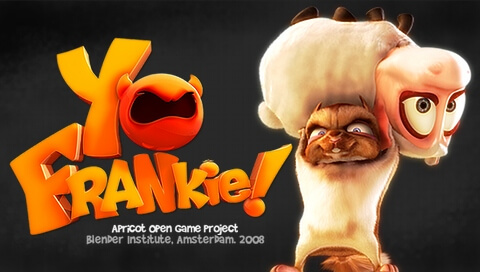
You may remember project Orange’s open movie “Elephants Dream” and project Peach’s open movie “Big Buck Bunny“, they’ve continued with a new open project Apricot. This time it isn’t a movie but a 3D game! These are all projects by the Blender Foundation and the Institute for Open 3D Projects called the Blender Institute.
Elephants Dream:
Elephants Dream is the world’s first open movie, made entirely with open source graphics software such as Blender, and with all production files freely available to use however you please, under a Creative Commons license.
Big Buck Bunny:
As a follow-up to the successful project Orange’s “Elephants Dream”, the Blender Foundation initiated another open movie project. Again a small team (7) of the best 3D artists and developers in the Blender community have been invited to come together to work in Amsterdam from October 2007 until April 2008 on completing a short 3D animation movie. The team members will get a great studio facility and housing in Amsterdam, all travel costs reimbursed, and a fee sufficient to cover all expenses during the period.
The creative concept of “Peach” was completely different as for “Orange”. This time it is “funny and furry”!
After Orange and Peach, Blender Institute continues with a new open project: Apricot. This time it isn’t a movie but a 3D game! Starting february 1st 2008, a small team of again the best 3D artist and developers will develop a game jointly with the on-line community. The main characters in the game are based on the short 3D animation open movie Peach
At the end of July 2008 the production ends and August is used for DVD and documentation making. Releasing the game at end of August.
Apricot Blender Game Engine Work in Progress 28/July from Campbell Barton on Vimeo.
Grab the OGG Theora file (46mb)
Wow how awesome does that look. Recently I’ve been using Blender for doing my video sequencing. Basically putting a collection of video clips in order to some syncronised audio. I wasn’t aware it was so easy to do this with Blender :D
I’m going to buy the Essential Blender book.
DRM down under
August 8, 2008 by Chris · Leave a Comment
Source: DRM down under

The Australian Broadcasting Company (ABC) is Australia’s Federal Government-funded public broadcaster, and has responsibilities under the ABC Act 1983 to provide services to the Australian people.
The new ABC Shop has recently launched, with downloads of TV programs made available — but only to Windows users willing to install Digital Restrictions Management (DRM) software on their computers. Like the BBC iPlayer, and Channel Four’s “4OD”, ABC is using the Kontiki platform — Kontiki uses peer-to-peer technology to deliver the show to other people, so as well as locking you into its restrictions, ABC is using your computer, and your internet connection, to distribute programs.
ABC claims it has a commitment to “respecting legitimate rights to privacy and confidentiality”, yet it is well-known that DRM is vehemently anti-privacy, and forcing Australian citizens to install proprietary, secret software from foreign corporations does not seem a good way to uphold privacy of its viewers.
We do not object to ABC charging money to download programs, only to their use of DRM. DRM isn’t necessary for enabling sustainable production and distribution of media — you don’t have to look any further than our own guide to DRM-free living to see that plenty of artists and businesses are doing it.
Please contact ABC Online, and the Australian Communications and Media Authority (ACMA). Telephone ACMA (toll free) on 1-800-22-6667 or write to them at PO Box Q500, Queen Victoria Building, NSW 1230. If you’re sending any emails, please CC them to us as well at info@defectivebydesign.org.
Let the ABC know you’re writing to them from Defective by Design and that you don’t want these restrictions on programs you’ve downloaded!
Point out that the DRM:
- locks out people who use free software. A public service should not require citizens to install software that takes away their freedom in order to access that service.
- forces ABC, a public broadcast service, to become dependent on Kontiki and Microsoft — private, proprietary, secretive and profit-motivated corporations. These corporations, by turning off their DRM systems, can deny people access to the media permanently. This has already happened with Google Video, Major League Baseball, and others.
- prevents citizens from making legitimate use of the media they’ve funded, such as taking clips for reviews and articles, or sharing interesting programs with friends.
Thanks to Andrew for bringing this to our attention. We try to keep up to date on as many things as we can, but we rely on readers and supporters to keep us informed and tip us off about things like this. Please keep sending tips and updates to info@defectivebydesign.org.
BadVista campaign
August 6, 2008 by Cath · Leave a Comment
In January the Green Party and Greenpeace issued warnings about the tremendous threat posed to the environment by the disposable computer mentality promoted in Microsoft’s $500-million Windows Vista marketing campaign. Vista has steep hardware requirements which in turn means that to use it, most people will have to throw their current computer into a landfill and buy a new one.
Vista is essentially designed to monitor what people do, and in particular to limit what they can do with digital media files. These limits obstruct common and legally protected uses like sharing news story clips and copying text from government documents. Vista has been engineered from the ground up as a DRM and Treacherous Computing platform.
Vista has also been designed for easy updating from a central authority, so that new restrictions can always be imposed, disabling certain features or programs.
Fortunately, people do not have to accept these restrictions on their freedom. Instead, they can reject Microsoft Windows Vista in favour of a free software distribution of GNU/Linux.
The FSF has a petition for anyone who wishes to join them in speaking out against these restrictions, as organizations or individuals.
Apple Iphone application withdrawn
August 3, 2008 by Cath · 7 Comments

Rotten Apple
Yesterday Nullriver Software released a highly sought-after application for the Apple Iphone. The application named Netshare enables users to utilise their Iphone internet access through their Wifi-equipped PC or laptop. Yesterday the application was released for delivery on Itunes and within hours of availability was removed by Apple without explanation. It then became available a second time before being pulled again. Its surprising that Apple allowed it to be released in the first place.
Nullriver seem to be in the dark as regards to why the app was pulled, they made this statement:
Update: NetShare is now back up and available from the AppStore! We’re not quite sure why Apple took down the NetShare application yet, we’ve received no communication from Apple thus far. NetShare did not violate any of the Developer or AppStore agreements. We’re hoping we’ll get some feedback from Apple today. Sorry to all the folks that couldn’t get it in time. We’ll do our best to try to get the application back onto the AppStore if at all possible. At the very least, we hope Apple will allow it to be used in countries where the provider does permit tethering.
This is the problem for those who purchase closed-systems or proprietary software, they are in the hands of the original manufacturers who effectively tell you what you can and can’t do.